
Category: Technologies Insights

  • Top AI Tools Every Student Should Know in 2026

    Top AI Tools Every Student Should Know in 2026

    Quick answer: The top AI tools every student should know in 2026 can help with studying, research, writing, presentations, coding and productivity. Tools such as ChatGPT, Google Gemini, Microsoft Copilot, Perplexity, NotebookLM and Canva AI can make learning easier when used responsibly.

    If you are a student in 2026, you do not need to learn every AI tool available online. The first thing to understand is that AI tools are designed to assist your learning, not replace your knowledge and thinking.

    What are AI tools and why should students know about them?

    AI tools are software platforms that use artificial intelligence to help users complete different tasks. Students can use them for learning, research, writing, creativity, organisation and technical skills.

    Practical consequence: if you learn how to use AI tools properly, you can save time and improve your productivity. However, you should still understand the subject yourself instead of depending completely on AI-generated answers.

    What can AI tools actually help students do?

    Worth being clear about. AI tools can support learning and productivity, but they should not be treated as a replacement for teachers, books or independent thinking.

    • Studying: explaining difficult concepts and helping students understand topics.
    • Research: helping students explore subjects and find relevant information.
    • Writing: improving grammar, structure and clarity.
    • Presentations: helping create ideas, designs and visual content.
    • Organisation: managing notes, projects and study plans.
    • Coding: helping students understand programming concepts and solve technical problems.

    Which AI tools should every student know in 2026?

    Students do not need to use every AI platform. The right tool depends on what you want to do.

    Some of the most useful AI tools students should know include ChatGPT, Google Gemini, Microsoft Copilot, Perplexity, NotebookLM and Canva AI.

    You should choose tools based on your actual requirements rather than downloading every new AI application.

    Is ChatGPT useful for students?

    ChatGPT can be useful for students who want help understanding difficult concepts, generating ideas and organising their learning.

    Students can use ChatGPT for:

    • Explaining difficult topics
    • Creating study plans
    • Generating practice questions
    • Brainstorming ideas
    • Improving writing
    • Understanding concepts
    • Learning basic coding

    However, students should not simply copy answers without understanding them.

    What is Google Gemini useful for?

    Google Gemini can help students with research, learning, writing and productivity-related tasks.

    Students can use it to explore topics, generate ideas and understand information more easily.

    What is Perplexity useful for?

    Perplexity can be particularly useful for students who want to research a topic and explore information from different sources.

    Students can use it for:

    • Topic research
    • Exploring current information
    • Finding sources
    • Comparing information
    • Understanding complex subjects

    For academic assignments, students should always check the original sources before using information.

    What is NotebookLM useful for?

    NotebookLM can be useful for students working with notes, documents and study material.

    It can help students:

    • Organise study material
    • Summarise notes
    • Understand documents
    • Generate questions
    • Review important topics

    This can be particularly useful when preparing for examinations or working with large amounts of study material.

    What is Canva AI useful for?

    Canva AI can help students create visual content for projects and presentations.

    Students can use it for:

    • Presentations
    • Posters
    • Infographics
    • College projects
    • Visual assignments
    • Creative content

    Good visual communication can help students present their ideas more effectively.

    What do AI tools actually help students with?

    Knowing the name of an AI tool is useful, but understanding which tool to use for a specific task is more important.

    AI ToolWhat students can use it for
    CHATGPTLearning, explanations, ideas and study assistance
    GOOGLE GEMINIResearch, writing and productivity
    MICROSOFT COPILOTProductivity, documents and assistance
    PERPLEXITYResearch and source exploration
    NOTEBOOKLMNotes, documents and study material
    CANVA AIPresentations, design and visual projects

    If you are a student in 2026, you have an advantage that previous generations did not: access to powerful learning tools. The important thing is learning how to use them correctly.

    The three mistakes students make most often when using AI tools

    Students often make the same three mistakes when they start using AI tools. None of them are about not having access to expensive technology. They are skills that can be developed with practice.

    1. Copying without understanding

    Students sometimes copy AI-generated answers directly into assignments or projects.

    This may save time temporarily, but it does not help you understand the subject. AI should help you learn, not do all your thinking for you.

    A better approach is to ask the AI tool to explain the topic and then write your answer based on your own understanding.

    2. Trusting every answer

    AI tools can sometimes provide incorrect, incomplete or outdated information.

    Students should verify important facts, statistics and academic information before using them.

    Checking reliable sources is an important skill when working with AI.

    3. Using AI for everything

    Some students become dependent on AI tools for even simple tasks.

    AI should improve your productivity, but you should continue developing your own writing, research, communication and problem-solving skills.

    The best students will learn how to combine AI tools with human thinking.

    Frequently Asked Questions

    Q: Which is the best AI tool for students in 2026?

    A: There is no single best AI tool for every student. ChatGPT can help with learning and explanations, Perplexity can support research, NotebookLM can help with study material and Canva AI can be useful for presentations.

    Q: Can students use AI tools for studying?

    A: Yes. AI tools can help students understand difficult concepts, organise notes, create study plans and generate practice questions.

    Q: Can I use AI for school or college assignments?

    A: You should follow the academic policies of your school or college. AI can help with research and learning, but submitting AI-generated work as your own may not be permitted.

    Q: Which AI tool is best for research?

    A: AI-powered research tools such as Perplexity can help students explore topics and find information. Important information should always be verified using reliable original sources.

    Q: Which AI tool is best for presentations?

    A: Canva AI can be useful for students creating presentations, posters and visual projects.

    Q: Should every student learn how to use AI?

    A: Basic AI knowledge can be useful because artificial intelligence is becoming increasingly important in education and workplaces. Students should learn how to use AI responsibly while continuing to develop their own knowledge and critical-thinking skills.
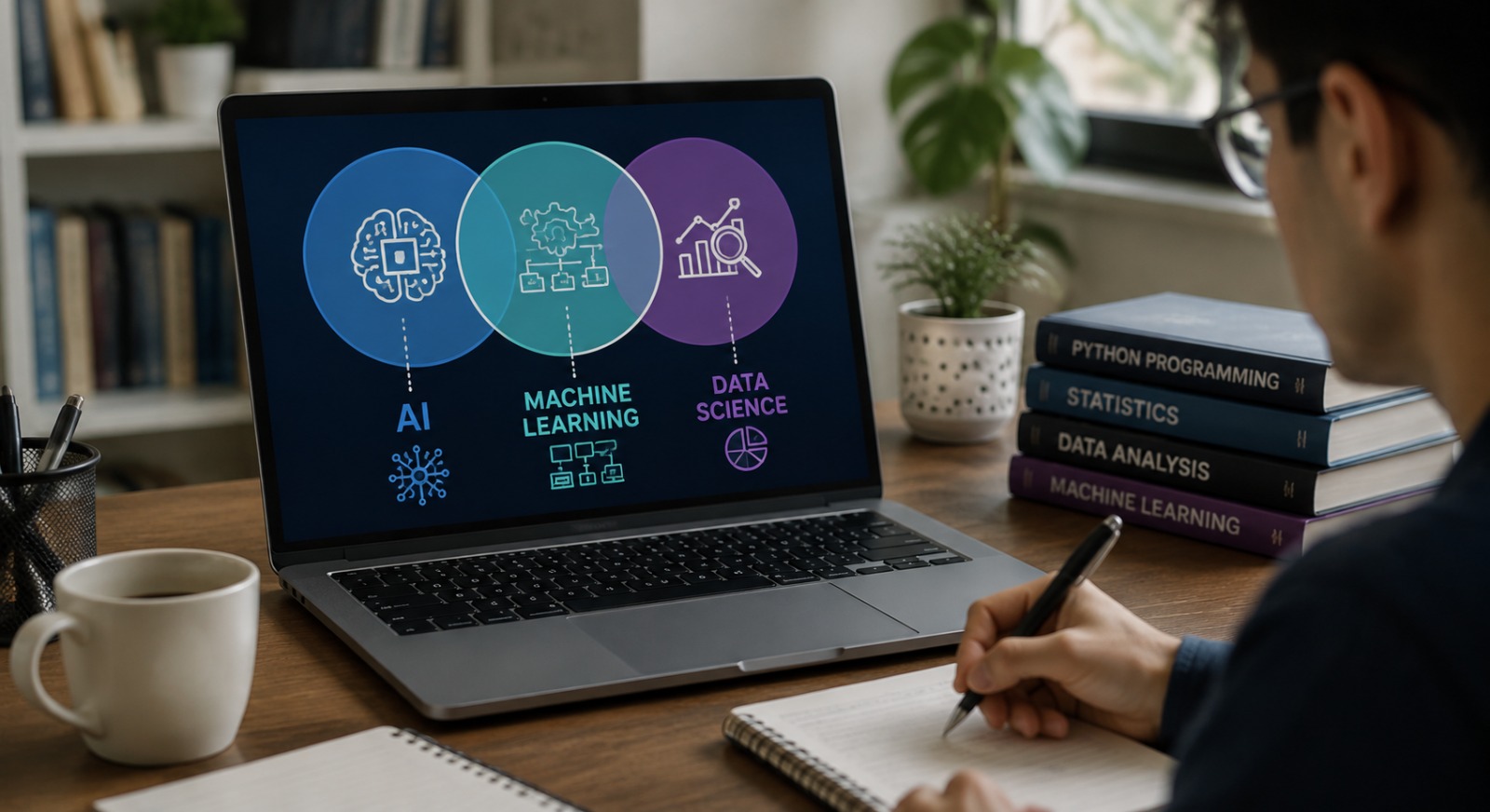

  • AI vs Machine Learning vs Data Science: What the Difference?

    AI vs Machine Learning vs Data Science: What the Difference?

    Quick answer: Artificial Intelligence (AI), Machine Learning and Data Science are closely connected, but they are not the same thing. AI is the broader field of creating systems that can perform tasks associated with human intelligence. Machine Learning is a part of AI that helps systems learn patterns from data. Data Science focuses on collecting, analysing and interpreting data to generate useful insights and solve problems.

    If you are interested in technology and searching for an AI or Data Science career, you may see these three terms used together frequently. The first thing to understand is that learning AI does not automatically mean you are studying Machine Learning, and learning Data Science does not necessarily mean you are building AI systems.

    These fields overlap in many areas, which is why students often find them confusing. However, each field has a different primary purpose and requires a different combination of skills.

    Is AI the same as Machine Learning and Data Science?

    Mostly no, and the difference is important to understand before choosing a course or career path.

    Artificial Intelligence is the broadest of the three concepts. Machine Learning is one area within AI, while Data Science is a broader field focused on working with data and can use Machine Learning and AI techniques as part of its work.

    What does Artificial Intelligence actually do?

    Worth being clear about. Artificial Intelligence involves creating systems that can perform tasks that usually require aspects of human intelligence.

    AI systems can be designed to analyse information, recognise patterns, understand language, generate content and support decision-making.

    • Understanding information: AI systems can process large amounts of information.
    • Recognising patterns: AI can identify patterns in images, text and other types of data.
    • Language: AI can work with human language through chatbots and language-processing systems.
    • Decision support: AI can help analyse information and support decisions.
    • Content generation: Generative AI can create text, images, code and other content.
    • Automation: AI can help automate certain repetitive tasks and workflows.

    If this sounds like an area you would enjoy, Artificial Intelligence provides a broad field with different specialisations to explore.

    What is Machine Learning, and how is it different from AI?

    Machine Learning is generally considered a part of Artificial Intelligence.

    Instead of programming every possible rule manually, Machine Learning systems can learn patterns from examples and data.

    For example, a Machine Learning model may analyse previous information to identify patterns and make predictions.

    Machine Learning can be used for:

    • Classification
    • Predictions
    • Recommendation systems
    • Pattern recognition
    • Fraud detection
    • Image recognition

    What does a Data Scientist actually do?

    Worth being realistic about. Data Science is not simply about creating charts or collecting information.

    Data Scientists and data professionals work with information to identify patterns, generate insights and support decision-making.

    Depending on the role, Data Science can involve:

    • Data collection: gathering relevant information from different sources.
    • Data cleaning: preparing information for analysis.
    • Data analysis: identifying patterns and trends.
    • Statistics: understanding relationships and interpreting results.
    • Data visualisation: presenting information through charts and dashboards.
    • Machine Learning: using models when prediction or pattern recognition is required.

    Do you need to learn all three fields?

    You generally do not need to become an expert in AI, Machine Learning and Data Science at the same time.

    The best learning path depends on the type of work you are interested in.

    A student interested in AI applications may begin with AI fundamentals and programming. Someone interested in building predictive models may focus more heavily on Machine Learning. A student interested in analysing information and finding business insights may focus on Data Science and analytics.

    Do you need to be good at mathematics?

    This is one of the questions students ask most, and it deserves a practical answer rather than a simple yes or no.

    The level of mathematics required depends on the area you want to study.

    Data analysis and beginner-level AI applications may require different mathematical knowledge compared with advanced Machine Learning or AI research.

    Areas that can become important include:

    • Basic mathematics
    • Statistics
    • Probability
    • Logical thinking
    • Analytical problem-solving

    If you are interested in these fields, do not assume that you must already be an expert in mathematics before you start learning.

    What we tell students who are confused about which field to choose

    If you are confused between AI, Machine Learning and Data Science, you should not choose a field simply because one title sounds more popular.

    Being a beginner means you have an opportunity to explore the fundamentals before specialising.

    You can begin by learning basic programming, understanding data and exploring AI concepts. As you gain experience, it may become easier to identify whether you enjoy analysing data, building models or working on broader AI applications.

    Can students from non-technical backgrounds learn AI, Machine Learning or Data Science?

    Yes. Students from different educational backgrounds can begin learning about AI, Machine Learning and Data Science.

    However, the technical requirements can vary depending on the career path you choose.

    A student interested in AI tools, business applications or data analytics may begin with different skills compared with someone who wants to build advanced Machine Learning systems.

    Technical roles can require stronger knowledge of:

    • Programming
    • Mathematics
    • Statistics
    • Data structures
    • Analytical thinking

    If you are from a non-technical background, you can start by understanding the fundamentals and gradually develop the technical skills required for the path you choose.

    What skills are actually different between AI, Machine Learning and Data Science?

    Understanding the differences can make it easier to choose what you want to learn.

    FieldMain FocusCommon Skills
    ARTIFICIAL INTELLIGENCECreating intelligent systems and applicationsAI concepts, programming, problem-solving, algorithms
    MACHINE LEARNINGTraining systems to learn patterns from dataPython, mathematics, statistics, model development
    DATA SCIENCEAnalysing data to generate insights and solve problemsData analysis, statistics, Python, visualisation

    The three fields often overlap, which is why professionals may develop skills from more than one area.

    If you are beginning your journey, you have an advantage that many students overlook: you can build the fundamentals before deciding on a specialisation.

    The three mistakes students make when choosing between AI, Machine Learning and Data Science

    Students often make similar mistakes when choosing a technology course. Most of these mistakes are not about intelligence or academic background. They are about choosing a path without understanding what the work actually involves.

    1. Choosing based only on the job title

    Students sometimes choose AI, Machine Learning or Data Science simply because they have heard that a particular field has good career opportunities.

    A job title alone does not explain what skills you will need or what type of work you will enjoy.

    Understanding programming, data, mathematics and problem-solving requirements can help you make a more informed decision.

    2. Assuming all three fields are exactly the same

    AI, Machine Learning and Data Science are connected, but they have different primary purposes.

    Trying to understand the relationship between them can help you choose the right learning path.

    You do not need to master every area immediately. Start with the fundamentals and gradually explore the areas that interest you most.

    3. Learning theory without practical projects

    A student may understand definitions but never apply their knowledge.

    Practical projects can help you understand how these fields work in real situations.

    Try working on projects involving:

    • Data analysis
    • Python programming
    • Machine Learning models
    • AI applications
    • Data visualisation

    Building projects can also help you demonstrate your practical knowledge.

    Frequently Asked Questions

    Q: What is the main difference between AI, Machine Learning and Data Science?

    A: AI is the broad field of creating intelligent systems. Machine Learning is a part of AI that focuses on learning patterns from data. Data Science focuses on collecting, analysing and interpreting data to generate useful insights.

    Q: Is Machine Learning part of AI?

    A: Yes. Machine Learning is generally considered a branch or approach within the broader field of Artificial Intelligence.

    Q: Is Data Science part of AI?

    A: Not exactly. Data Science is a broader field focused on working with data. It can use AI and Machine Learning techniques, but not all Data Science work involves Artificial Intelligence.

    Q: Which is easier to learn: AI, Machine Learning or Data Science?

    A: The difficulty depends on your background and the area you want to study. Beginners can start with programming and data fundamentals before moving towards more advanced AI or Machine Learning concepts.

    Q: Do I need coding for AI and Machine Learning?

    A: Coding is important for many technical AI and Machine Learning roles. Python is widely used for working with data, Machine Learning and AI applications.

    Q: Can students from non-technical backgrounds learn Data Science?

    A: Yes. Students from different backgrounds can begin learning Data Science fundamentals. Depending on the career path, they may need to gradually develop programming, statistics and analytical skills.

    Q: Which career should I choose: AI, Machine Learning or Data Science?

    A: The best choice depends on your interests. If you enjoy intelligent systems and AI applications, AI may interest you. If you enjoy building predictive models, Machine Learning may be suitable. If you enjoy analysing data and finding insights, Data Science may be a better fit.

  • Top AI Skills to Learn in 2025 for a Future-Ready Career

    Top AI Skills to Learn in 2025 for a Future-Ready Career

    Quick answer: The best AI skills to learn in 2025 depend on the type of career you want to build, but a strong foundation usually includes AI fundamentals, data analysis, Python programming, machine learning concepts, generative AI, prompt engineering and problem-solving. You do not need to learn every AI technology at once. The better approach is to understand the fundamentals and gradually develop practical skills through learning and projects.

    If you are interested in Artificial Intelligence and already thinking about a future-ready career, you do not need to rush into learning every new AI tool you see online. The first thing to understand is that employers do not hire someone simply because they know how to use one popular AI tool. They look for people who can understand problems, work with technology and data, and apply their skills in practical situations.

    An AI training programme can help you understand programming, data and artificial intelligence concepts, but completing a course alone does not automatically guarantee a job.

    This article covers the top AI skills to learn in 2025, which skills are useful for beginners, what different AI career paths involve and how you can build a stronger foundation for a future-ready career.

    What exactly are AI skills?

    Worth being clear about. AI skills are not limited to building robots or creating complex artificial intelligence systems.

    Artificial Intelligence is a broad field that includes different technologies, tools and applications. Some professionals work on developing machine learning models, while others use AI to analyse data, automate processes, build applications or solve business problems.

    The practical consequence is that if you only search for one term such as “AI course,” you may miss important areas such as Data Science, Machine Learning, Generative AI, AI Automation and Data Analytics.

    Before choosing what to learn, it is useful to understand the different skills involved.

    What does working with AI actually involve?

    Worth being realistic about. Working with AI is not simply about asking questions to ChatGPT or using an AI image generator.

    Depending on the role, AI professionals may work with data, programming, machine learning systems, automation and business problems.

    • Data: collecting, cleaning and understanding information before it can be used effectively.
    • Programming: writing code to create applications, analyse data and work with AI systems.
    • Machine learning: training systems to identify patterns and make predictions.
    • Generative AI: working with systems that can generate text, images, code and other content.
    • Automation: using AI and technology to reduce repetitive tasks and improve workflows.
    • Problem-solving: understanding real-world challenges and identifying where technology can help.

    If this sounds like an area you would enjoy, learning AI skills can be a useful way to prepare for future technology and data-focused opportunities.

    Do you need a degree to learn AI skills or build an AI career?

    You do not need to wait until you complete a degree to start learning AI skills. Students can begin developing knowledge in programming, data analysis and AI fundamentals while continuing their school or college education.

    However, the educational requirements for specific jobs can vary depending on the employer and the role.

    You also do not necessarily need to come from one particular academic background to start learning AI. Students from Science, Commerce and other backgrounds can begin exploring AI-related skills, although technical roles involving programming and advanced mathematics may require additional preparation.

    If you are a student, your priority should therefore be building strong fundamentals while continuing your education.

    What matters is not simply the name of the course you complete. Your understanding of programming, data, problem-solving and your ability to apply knowledge practically can become important when building a technology-focused career.

    What is the best age to start learning AI?

    There is no single age at which someone must start learning AI.

    Students can begin exploring basic technology and AI concepts at different stages of their education. Beginners can start with AI fundamentals and gradually move towards programming, data analysis and more advanced concepts.

    If you are still studying, you have time to understand different career paths and discover which areas of technology interest you most.

    The important thing is to learn at an appropriate level and build knowledge step by step instead of immediately jumping into highly advanced machine learning concepts.

    At Amigo Academy, the AI & Data Science programme is designed as an industry-oriented professional training programme. Students should understand the programme requirements and choose training based on their educational background, interests and career goals.

    Do you need to be good at mathematics?

    This is one of the questions students ask most, and it deserves a practical answer rather than a simple yes or no.

    Different areas of AI require different levels of mathematics.

    Some beginner-level AI tools and practical applications can be explored without advanced mathematics. However, areas such as Data Science, Machine Learning and advanced AI development can involve statistics, probability and mathematical concepts.

    If you are interested in AI, do not assume that you must already be an expert in mathematics before you start learning.

    Instead, begin by understanding the requirements of the particular AI field you are interested in and gradually strengthen the skills you need.

    It is also important to understand the difference between learning how to use AI tools and becoming a technical AI professional. Using an AI tool effectively does not automatically mean you understand machine learning or can develop AI systems.

    What we tell students who feel they are not technical enough

    If you feel that programming, mathematics or technology is difficult for you, you should understand your current strengths before choosing an advanced AI learning path.

    Being a beginner does not mean you cannot learn AI-related skills. It means you may need to start with the fundamentals and progress gradually.

    You can begin by exploring areas such as AI fundamentals, digital tools, data basics and problem-solving before moving towards programming and advanced machine learning.

    There is no responsible way for an institute to guarantee that every student will become an AI engineer or secure a particular job simply by completing a course. Your progress depends on your learning, practice, projects and the skills you develop.

    Can students from non-technical backgrounds learn AI?

    Yes. Students from different educational backgrounds can begin learning about AI and its applications.

    However, different career paths require different levels of technical knowledge.

    A student interested in using AI for business, marketing, automation or productivity may follow a different learning path from someone who wants to become a machine learning engineer or data scientist.

    Technical AI roles may require stronger knowledge of programming, mathematics and data.

    If you are from a non-technical background and interested in AI, you can start by understanding the fundamentals and gradually explore the areas that match your interests.

    What do employers actually look for in AI candidates?

    A course certificate may help demonstrate that you have completed training. Your practical skills and ability to apply knowledge can become important when you move towards internships or job opportunities.

    Skill AreaWhat is being developed
    AI FUNDAMENTALSUnderstanding basic AI concepts, applications and limitations
    DATA ANALYSISWorking with information, identifying patterns and understanding insights
    PYTHON PROGRAMMINGProgramming fundamentals and technical problem-solving
    MACHINE LEARNINGUnderstanding models, training data and prediction concepts
    GENERATIVE AIUsing and evaluating AI-generated outputs effectively
    PROBLEM-SOLVINGApplying technology and AI to real-world challenges

    If you are starting your AI journey, you have an advantage that many people overlook: time to practise. You can gradually build your knowledge and practical skills before applying for advanced opportunities.

    The three mistakes we see most often when students start learning AI

    Students often make similar mistakes when they begin exploring Artificial Intelligence. Most of these mistakes are not about intelligence or academic background. They are about the way students approach learning.

    1. Learning only AI tools

    Students sometimes focus only on learning the latest AI application or platform.

    AI tools can change quickly. If you only learn one specific tool without understanding the underlying concepts, your knowledge can become limited.

    Building fundamentals in data, programming, problem-solving and AI concepts can provide a stronger long-term foundation.

    2. Trying to learn everything at once

    A student may see courses about Python, Machine Learning, Data Science, Generative AI, Deep Learning and AI Automation and try to learn everything simultaneously.

    This can become confusing.

    Artificial Intelligence is a broad field. It is usually better to begin with the fundamentals and gradually develop your skills based on the career path that interests you.

    3. Learning without practical projects

    A student may watch videos and complete lessons but never apply their knowledge.

    Practical learning is important because it helps you understand how AI and data concepts work in real situations.

    Try to work on projects involving data analysis, Python programming, AI tools, automation or other areas you are learning.

    Building projects can also help you develop a portfolio of practical work.

    Frequently Asked Questions

    Q: Which AI skill should I learn first?

    A: Beginners can start by understanding AI fundamentals and then explore areas such as Python programming and data analysis based on their interests and career goals.

    Q: Can beginners learn AI?

    A: Yes. Beginners can start with basic concepts and gradually develop programming, data and practical AI skills.

    Q: Do I need coding to learn AI?

    A: Coding is important for many technical AI roles. However, some practical AI applications, automation tools and business-focused uses may require different levels of programming knowledge.

    Q: Which programming language is useful for AI?

    A: Python is widely used in AI, Machine Learning and Data Science and is commonly considered a useful programming language for beginners.

    Q: Is mathematics compulsory for AI?

    A: Different areas of AI require different levels of mathematics. Advanced Machine Learning and Data Science can involve mathematical and statistical concepts, while some beginner-level AI applications may not require advanced mathematics.

    Q: Can students from non-technical backgrounds learn AI?

    A: Yes. Students from different backgrounds can start learning AI fundamentals and explore AI applications. The technical requirements will depend on the specific career path they choose.

    Q: How can I prepare for an AI and Data Science career?

    A: Focus on building fundamentals in programming, data analysis, problem-solving and practical projects. Continue learning as technology develops and build experience by applying your knowledge.