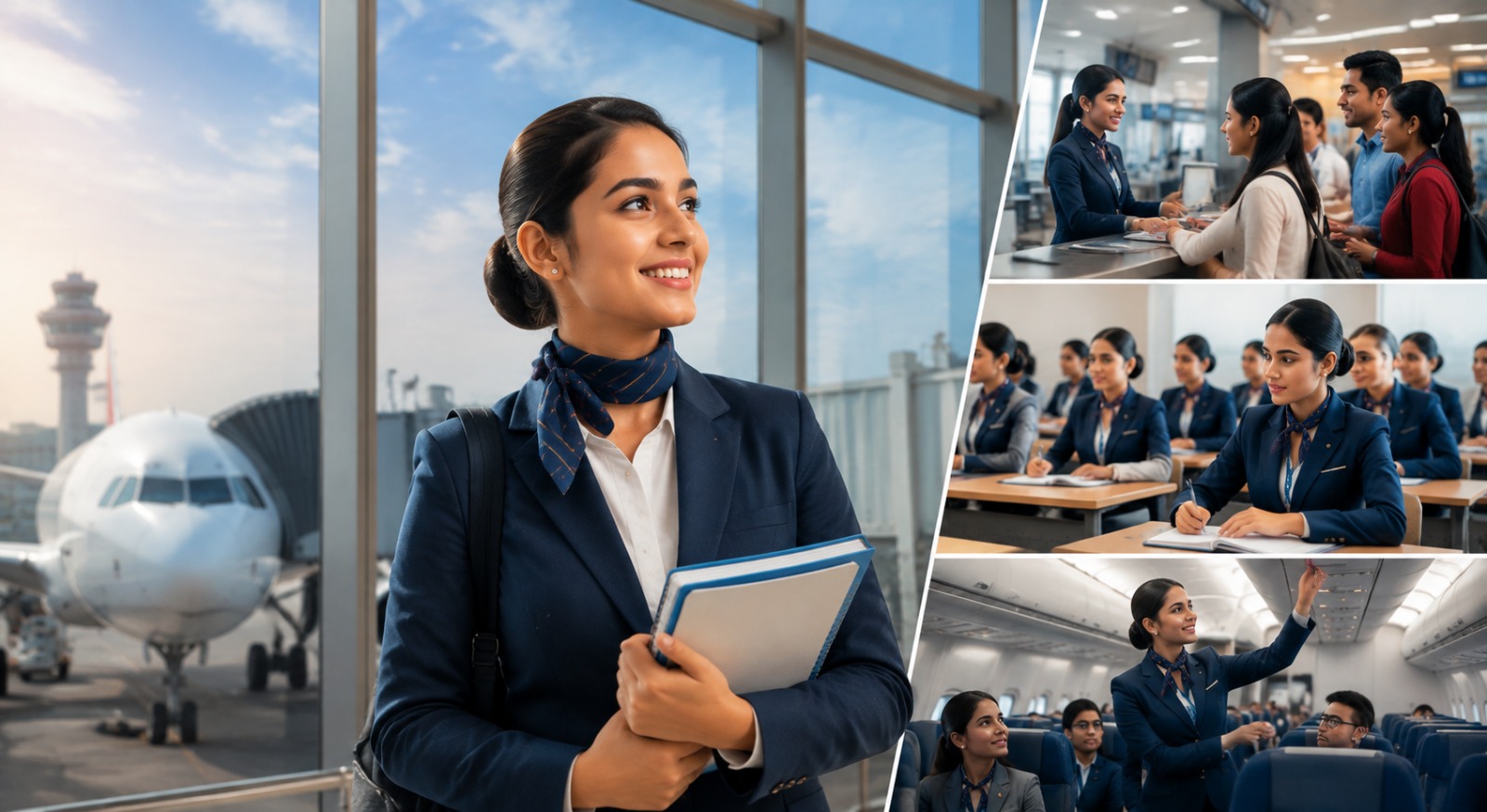
Quick answer: Yes, you can become an air hostess after Class 12 — no degree is required and no particular stream. Airlines recruit adult candidates who meet their own current age, education, medical and physical requirements, and those criteria vary by airline and by recruitment drive. A training course is not compulsory and does not get you hired. What it can do is help you prepare for important parts of the selection process — the interview, the grooming round and the group discussion.
If you have just finished 12th and you are looking at cabin crew, the first thing worth understanding is that airlines do not hire you because you completed a course. They hire you because you passed their selection process. Any institute that suggests otherwise is selling you something.
That said, the selection process is where many first-time candidates come unstuck — not on paper eligibility. This article covers what airlines actually check, what you can influence, and what a course can and cannot do for you.
Is “air hostess” the same as cabin crew?
Mostly yes, and the difference is worth knowing before you start searching. “Air hostess” is the term almost everyone in India uses, usually for female crew. Airlines themselves advertise the role as cabin crew, cabin crew member or flight attendant, and they recruit both women and men into it.
Practical consequence: if you search job sites for “air hostess vacancy” you will find a fraction of what is actually open. Search the airline’s own term instead. Throughout this article we use both, because you will meet both.
What does an air hostess actually do?
Worth being clear about. Cabin crew is first and foremost a safety role, with passenger service forming an important part of the job — something people often realise only after they start.
- Safety first: pre-flight equipment checks, safety demonstrations, and handling emergency procedures if they are ever needed. This is the part airlines train hardest on.
- Boarding: assisting passengers, managing cabin baggage, checking seatbelts and exits.
- In-flight service: meals, beverages, duty-free, and attending to passenger requests through the flight.
- Difficult situations: unwell passengers, anxious flyers, disagreements between passengers, occasionally people who have had too much to drink.
- Working as a crew: coordinating with the rest of the cabin crew and the flight deck throughout.
- The hours: early starts, late finishes, weekends, festivals, and nights away from home depending on your roster.
If that sounds like work you would enjoy, the rest of this article is worth reading. If the last two points give you pause, read the fit section further down before you spend anything.
Can you become an air hostess after 12th, or do you need a degree?
A Class 12 qualification is commonly sufficient to apply, and a specific academic stream is generally not required — Science, Commerce and Arts students all apply. Eligibility criteria vary by airline, so check the current requirements of the airline you want to apply to. A degree is not usually a requirement.
What matters far more is spoken English, presentation, and how you handle yourself in front of a panel. Those are learnable. Your stream is not something you need to worry about.
What is the age limit for an air hostess?
Airlines set their own age criteria and these vary by carrier and by recruitment drive. Check the current requirements on the careers page of the airline you intend to apply to rather than relying on a figure quoted elsewhere — including here.
At Amigo Academy the Cabin Crew programme admits students aged 17 to 24, which means a student who joins at 17 finishes training with several years of eligibility ahead of them.
What is the height requirement, honestly?
This is the question we are asked most, and it deserves a straight answer rather than a reassuring one.
Height requirements are not the same across airlines. Some specify a minimum height; others assess arm reach instead, since the practical requirement is being able to reach overhead safety equipment. Requirements also change between recruitment drives, so a figure you read on a forum two years ago may no longer hold.
Two things are worth being clear about. First, an institute’s admission criteria and an airline’s hiring criteria are different things — meeting ours does not mean you meet theirs, and we will not let you believe otherwise. Second, if you are below the standard for the airlines you want to apply to, you should know that before you pay for training, not after.
Our cabin crew height guide sets out both the airline standards and Amigo’s own admission criteria in full. If you are unsure where you stand, a counselling session will go through the current requirements with you and cover alternatives where cabin crew is not a realistic fit.
What we tell students who are below the requirement
If your height is below the requirement of the airlines you want to apply to, we say so directly, and we will usually point you towards our Airport Ground Staff programme instead — a career in aviation that does not carry the same physical requirement.
There is one exception we handle case by case. If you are only around 1 to 2 cm below the relevant requirement and you are 17 or 18, we may still consider admission after counselling, since students at that age may still be growing. We say clearly in that conversation that we cannot guarantee an increase in height, and we cannot guarantee that an airline will select you. What we will not do is take your fee for cabin crew training you may never be able to use.
Can boys become cabin crew or air hostesses?
Yes. Male cabin crew are employed across India’s major airlines. The role is often listed as flight steward, cabin crew member or in-flight attendant, and they perform the same core safety and passenger-service duties as any other cabin crew. Airlines apply their own eligibility criteria, and height standards are generally higher for men.
Cabin crew is marketed almost entirely at women in India, which leaves male applicants under-informed rather than unwelcome. Our programme is open to all students and the syllabus does not differ.
What do airlines actually screen for?
Paper eligibility gets you into the room. These are what decide whether you leave with an offer:
| Stage | What is being assessed |
|---|---|
| INITIAL SCREENING | Height, grooming, presentation, confidence walking in |
| GROUP DISCUSSION | Whether you contribute without dominating, and listen without disappearing |
| PERSONAL INTERVIEW | Spoken English, composure, why this job, how you handle a difficult scenario |
| GROOMING ROUND | Skin, hair, posture, uniform fit, visible tattoos or marks per airline policy |
| MEDICAL | Vision, general fitness, and the airline’s own medical standards |
For many candidates, the interview, group discussion and grooming stages prove more difficult than the initial eligibility check. Those are the parts worth preparing for deliberately.
The three mistakes we see most often in first airline interviews
Our trainers see the same three issues come up repeatedly when students attend their first airline interview. None of them are about eligibility, and all three are fixable with practice.
1. Grooming
Students underestimate how much overall presentation counts in an aviation interview. Hair, posture, dress and attention to detail all feed the first impression, and candidates are rarely told this is what cost them.
2. Confidence
A student knows the answer and then freezes in front of the panel — speaks too softly, hesitates, or cannot get the thought out clearly. Knowing the material and delivering it under pressure are two different skills.
3. Communication
This is not about vocabulary. It is about understanding what has been asked, answering that question clearly, and sounding like someone a passenger would want to be helped by.
Is an air hostess course compulsory?
No. Airlines do not require you to hold a course certificate, and anyone who tells you a certificate guarantees an interview is misleading you. Airlines run their own training after they hire you.
A course is worth doing for a narrower reason: it prepares you for a selection process that is difficult to prepare for alone. Mock interviews, grooming correction, group-discussion practice and structured spoken-English work are hard to replicate on your own, and these stages can be challenging for first-time candidates.
Amigo Academy’s Cabin Crew programme runs 6 months, five days a week, two hours a day, and is Maharashtra Government Certified. It covers aviation and airline industry knowledge, safety and emergency procedures, in-flight service, grooming and personality development, communication and soft skills, and interview preparation with mock sessions.
On interview preparation specifically: our mock sessions are scenario-based. Students are put into situations close to what a real airline interview throws at them and have to respond in the moment, rather than working through a list of likely questions and memorising answers.
The point is familiarity. When a student walks into a real airline interview, the room, the format and the pressure should feel like something they have already done — not something entirely new happening on the day that matters most.
What does an air hostess earn in India?
Cabin crew pay varies considerably by airline, role, experience, base city, flying hours and allowance structure — more than the headline figure usually suggests. Freshers start at an entry-level salary; experienced crew and senior roles earn substantially more. International carriers generally pay more and often include accommodation or travel allowances, but recruit less frequently and expect prior experience.
Current indicative ranges are set out in our cabin crew salary guide, which is the one place we keep those figures updated.
How long does it take to start earning?
Realistically: 6 months of training, then a recruitment cycle. Airlines hire in drives rather than continuously, so timing matters as much as readiness — you may finish training a month before a drive opens, or three months before. It is common for candidates to need more than one attempt, particularly while they are still sharpening interview, grooming and communication skills.
That is worth planning for rather than being surprised by. A rejection at the first drive is not a signal to stop.
Is an air hostess career actually right for you?
Worth being honest with yourself before you spend money on training. This job suits some people very well and makes others miserable, and the difference is rarely about ability.
| Probably a good fit if you | Think carefully if you |
|---|---|
| Enjoy dealing with people all day, including difficult ones | Find constant customer-facing work draining |
| Are comfortable with irregular hours and early starts | Want a predictable 9-to-5 |
| Do not mind working weekends and festivals | Need to be home for family occasions |
| Want to travel and can be away from home | Have commitments that make being away hard |
| Can stay calm when a situation goes wrong at 35,000 feet | Are uncomfortable with medical or safety responsibility |
None of these rule you out. But if most of the right-hand column describes you, airport ground staff may suit you better — same industry, often the same airport environment, and generally less travel.
What if you are not selected?
Many candidates are not, first time. Airlines can receive large numbers of applications during a recruitment drive, so competition is significant, and the reasons for a rejection are often specific and fixable — a grooming detail, nerves in the group discussion, an answer that did not land.
The other honest route is airport ground staff — another career path within aviation, often in the same airport environment and generally involving less travel. Our own Ground Staff programme admits students up to 27, against 24 for cabin crew, so it stays open longer. It is not a consolation prize; it is a different job in the same industry.
Step by step, if you are starting now
| Step | What to do |
|---|---|
| 1 | Check the current eligibility of two or three airlines you would realistically apply to. Not a generic list — their own careers pages. |
| 2 | Be honest about height and medical fitness now, not after you have paid for training. |
| 3 | Work on spoken English, confidence and clear communication. These are assessed throughout selection and take consistent practice over months. |
| 4 | Decide whether you need structured training or can prepare independently. Both are legitimate. |
| 5 | Prepare specifically for the interview, group discussion and grooming round — not just the syllabus. |
| 6 | Apply to multiple airlines across multiple drives. Expect to need more than one attempt. |
Frequently Asked Questions
Q: Can I become cabin crew after 12th commerce or arts?
A: Yes. A Class 12 pass from any stream can be eligible for cabin crew recruitment. Airlines set their own current eligibility criteria, so check the requirements of the airline you want to apply to.
Q: Is there a cabin crew course after 12th in Mumbai?
A: Yes. Amigo Academy provides a 6-month Maharashtra Government Certified Cabin Crew & Hospitality Management programme across Ghatkopar, Andheri, and Thane campuses.
Q: Do I need to be fluent in English?
A: You need to be clear and confident, not perfect. Spoken English is assessed throughout the selection process, and it is an area many candidates benefit from practising. Additional languages are an advantage.
Q: Can I apply if I have a tattoo?
A: It depends on the airline and on whether the tattoo is visible in uniform. Policies differ, so check the specific carrier’s requirements rather than assuming.
Q: How much does a cabin crew course cost?
A: Fees vary by institute and programme length. Amigo Academy offers a scholarship of up to ₹50,000 subject to eligibility, and EMI options. Speak to a counsellor for current fees.
Q: Can I become cabin crew without doing a training course?
A: Yes. A private cabin crew course is not automatically required by every airline — airlines run their own recruitment and their own training after hiring. Training can help you prepare for grooming, communication and interview stages, which can be challenging for first-time candidates, but it is a preparation choice rather than a qualification requirement.
Q: Is a cabin crew course compulsory after 12th?
A: No. No airline requires you to hold a private institute’s certificate to apply. Be cautious of anyone who tells you otherwise.
Q: Is cabin crew a long-term career?
A: It can be. Progression typically runs from cabin crew to senior crew to purser or in-flight supervisor, and some move into training, recruitment or ground operations roles. Many people fly for a period and then move sideways within aviation.
Leave a Reply