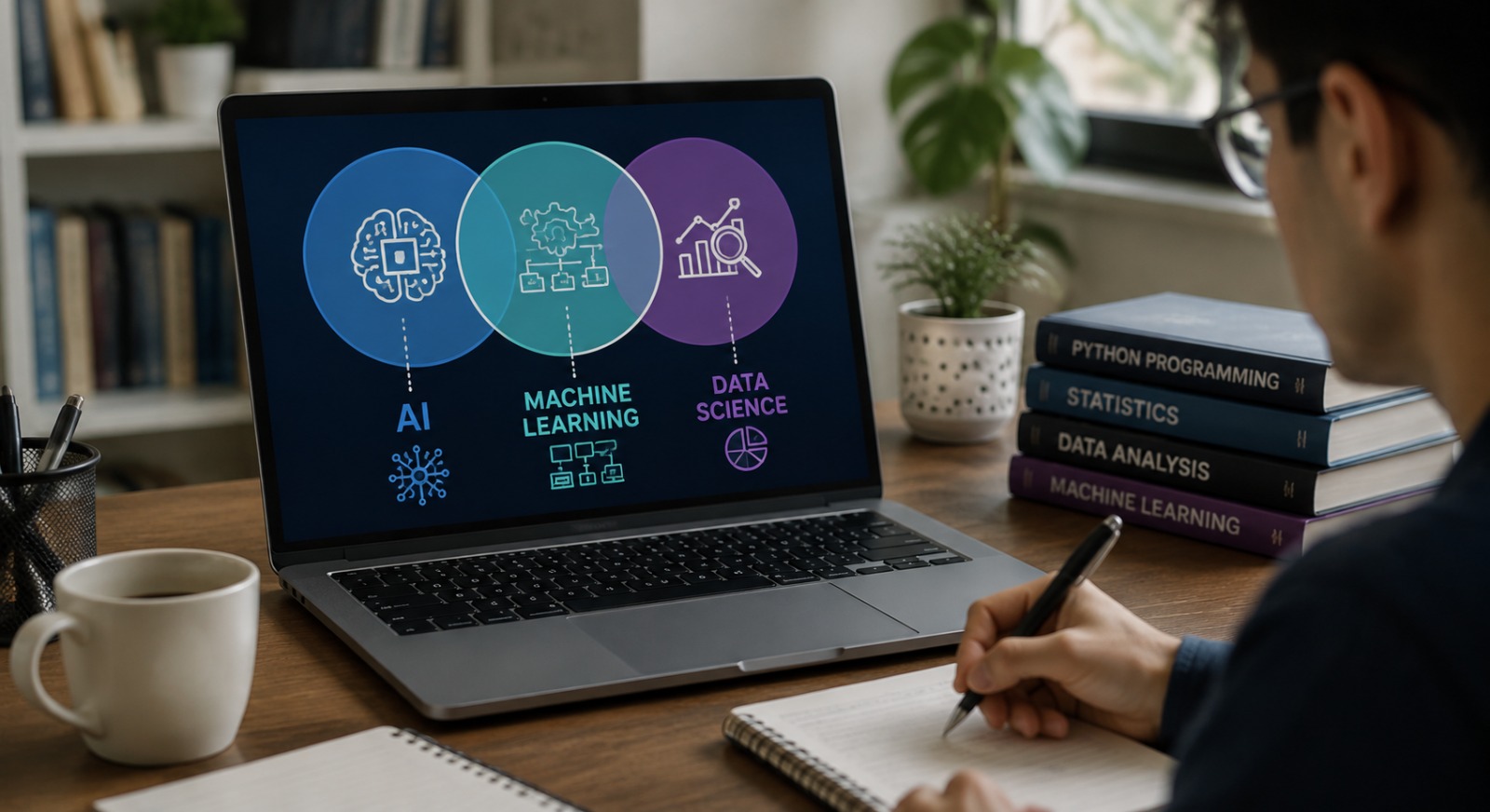
Quick answer: Artificial Intelligence (AI), Machine Learning and Data Science are closely connected, but they are not the same thing. AI is the broader field of creating systems that can perform tasks associated with human intelligence. Machine Learning is a part of AI that helps systems learn patterns from data. Data Science focuses on collecting, analysing and interpreting data to generate useful insights and solve problems.
If you are interested in technology and searching for an AI or Data Science career, you may see these three terms used together frequently. The first thing to understand is that learning AI does not automatically mean you are studying Machine Learning, and learning Data Science does not necessarily mean you are building AI systems.
These fields overlap in many areas, which is why students often find them confusing. However, each field has a different primary purpose and requires a different combination of skills.
Is AI the same as Machine Learning and Data Science?
Mostly no, and the difference is important to understand before choosing a course or career path.
Artificial Intelligence is the broadest of the three concepts. Machine Learning is one area within AI, while Data Science is a broader field focused on working with data and can use Machine Learning and AI techniques as part of its work.
What does Artificial Intelligence actually do?
Worth being clear about. Artificial Intelligence involves creating systems that can perform tasks that usually require aspects of human intelligence.
AI systems can be designed to analyse information, recognise patterns, understand language, generate content and support decision-making.
- Understanding information: AI systems can process large amounts of information.
- Recognising patterns: AI can identify patterns in images, text and other types of data.
- Language: AI can work with human language through chatbots and language-processing systems.
- Decision support: AI can help analyse information and support decisions.
- Content generation: Generative AI can create text, images, code and other content.
- Automation: AI can help automate certain repetitive tasks and workflows.
If this sounds like an area you would enjoy, Artificial Intelligence provides a broad field with different specialisations to explore.
What is Machine Learning, and how is it different from AI?
Machine Learning is generally considered a part of Artificial Intelligence.
Instead of programming every possible rule manually, Machine Learning systems can learn patterns from examples and data.
For example, a Machine Learning model may analyse previous information to identify patterns and make predictions.
Machine Learning can be used for:
- Classification
- Predictions
- Recommendation systems
- Pattern recognition
- Fraud detection
- Image recognition
What does a Data Scientist actually do?
Worth being realistic about. Data Science is not simply about creating charts or collecting information.
Data Scientists and data professionals work with information to identify patterns, generate insights and support decision-making.
Depending on the role, Data Science can involve:
- Data collection: gathering relevant information from different sources.
- Data cleaning: preparing information for analysis.
- Data analysis: identifying patterns and trends.
- Statistics: understanding relationships and interpreting results.
- Data visualisation: presenting information through charts and dashboards.
- Machine Learning: using models when prediction or pattern recognition is required.
Do you need to learn all three fields?
You generally do not need to become an expert in AI, Machine Learning and Data Science at the same time.
The best learning path depends on the type of work you are interested in.
A student interested in AI applications may begin with AI fundamentals and programming. Someone interested in building predictive models may focus more heavily on Machine Learning. A student interested in analysing information and finding business insights may focus on Data Science and analytics.
Do you need to be good at mathematics?
This is one of the questions students ask most, and it deserves a practical answer rather than a simple yes or no.
The level of mathematics required depends on the area you want to study.
Data analysis and beginner-level AI applications may require different mathematical knowledge compared with advanced Machine Learning or AI research.
Areas that can become important include:
- Basic mathematics
- Statistics
- Probability
- Logical thinking
- Analytical problem-solving
If you are interested in these fields, do not assume that you must already be an expert in mathematics before you start learning.
What we tell students who are confused about which field to choose
If you are confused between AI, Machine Learning and Data Science, you should not choose a field simply because one title sounds more popular.
Being a beginner means you have an opportunity to explore the fundamentals before specialising.
You can begin by learning basic programming, understanding data and exploring AI concepts. As you gain experience, it may become easier to identify whether you enjoy analysing data, building models or working on broader AI applications.
Can students from non-technical backgrounds learn AI, Machine Learning or Data Science?
Yes. Students from different educational backgrounds can begin learning about AI, Machine Learning and Data Science.
However, the technical requirements can vary depending on the career path you choose.
A student interested in AI tools, business applications or data analytics may begin with different skills compared with someone who wants to build advanced Machine Learning systems.
Technical roles can require stronger knowledge of:
- Programming
- Mathematics
- Statistics
- Data structures
- Analytical thinking
If you are from a non-technical background, you can start by understanding the fundamentals and gradually develop the technical skills required for the path you choose.
What skills are actually different between AI, Machine Learning and Data Science?
Understanding the differences can make it easier to choose what you want to learn.
| Field | Main Focus | Common Skills |
|---|---|---|
| ARTIFICIAL INTELLIGENCE | Creating intelligent systems and applications | AI concepts, programming, problem-solving, algorithms |
| MACHINE LEARNING | Training systems to learn patterns from data | Python, mathematics, statistics, model development |
| DATA SCIENCE | Analysing data to generate insights and solve problems | Data analysis, statistics, Python, visualisation |
The three fields often overlap, which is why professionals may develop skills from more than one area.
If you are beginning your journey, you have an advantage that many students overlook: you can build the fundamentals before deciding on a specialisation.
The three mistakes students make when choosing between AI, Machine Learning and Data Science
Students often make similar mistakes when choosing a technology course. Most of these mistakes are not about intelligence or academic background. They are about choosing a path without understanding what the work actually involves.
1. Choosing based only on the job title
Students sometimes choose AI, Machine Learning or Data Science simply because they have heard that a particular field has good career opportunities.
A job title alone does not explain what skills you will need or what type of work you will enjoy.
Understanding programming, data, mathematics and problem-solving requirements can help you make a more informed decision.
2. Assuming all three fields are exactly the same
AI, Machine Learning and Data Science are connected, but they have different primary purposes.
Trying to understand the relationship between them can help you choose the right learning path.
You do not need to master every area immediately. Start with the fundamentals and gradually explore the areas that interest you most.
3. Learning theory without practical projects
A student may understand definitions but never apply their knowledge.
Practical projects can help you understand how these fields work in real situations.
Try working on projects involving:
- Data analysis
- Python programming
- Machine Learning models
- AI applications
- Data visualisation
Building projects can also help you demonstrate your practical knowledge.
Frequently Asked Questions
Q: What is the main difference between AI, Machine Learning and Data Science?
A: AI is the broad field of creating intelligent systems. Machine Learning is a part of AI that focuses on learning patterns from data. Data Science focuses on collecting, analysing and interpreting data to generate useful insights.
Q: Is Machine Learning part of AI?
A: Yes. Machine Learning is generally considered a branch or approach within the broader field of Artificial Intelligence.
Q: Is Data Science part of AI?
A: Not exactly. Data Science is a broader field focused on working with data. It can use AI and Machine Learning techniques, but not all Data Science work involves Artificial Intelligence.
Q: Which is easier to learn: AI, Machine Learning or Data Science?
A: The difficulty depends on your background and the area you want to study. Beginners can start with programming and data fundamentals before moving towards more advanced AI or Machine Learning concepts.
Q: Do I need coding for AI and Machine Learning?
A: Coding is important for many technical AI and Machine Learning roles. Python is widely used for working with data, Machine Learning and AI applications.
Q: Can students from non-technical backgrounds learn Data Science?
A: Yes. Students from different backgrounds can begin learning Data Science fundamentals. Depending on the career path, they may need to gradually develop programming, statistics and analytical skills.
Q: Which career should I choose: AI, Machine Learning or Data Science?
A: The best choice depends on your interests. If you enjoy intelligent systems and AI applications, AI may interest you. If you enjoy building predictive models, Machine Learning may be suitable. If you enjoy analysing data and finding insights, Data Science may be a better fit.
Leave a Reply